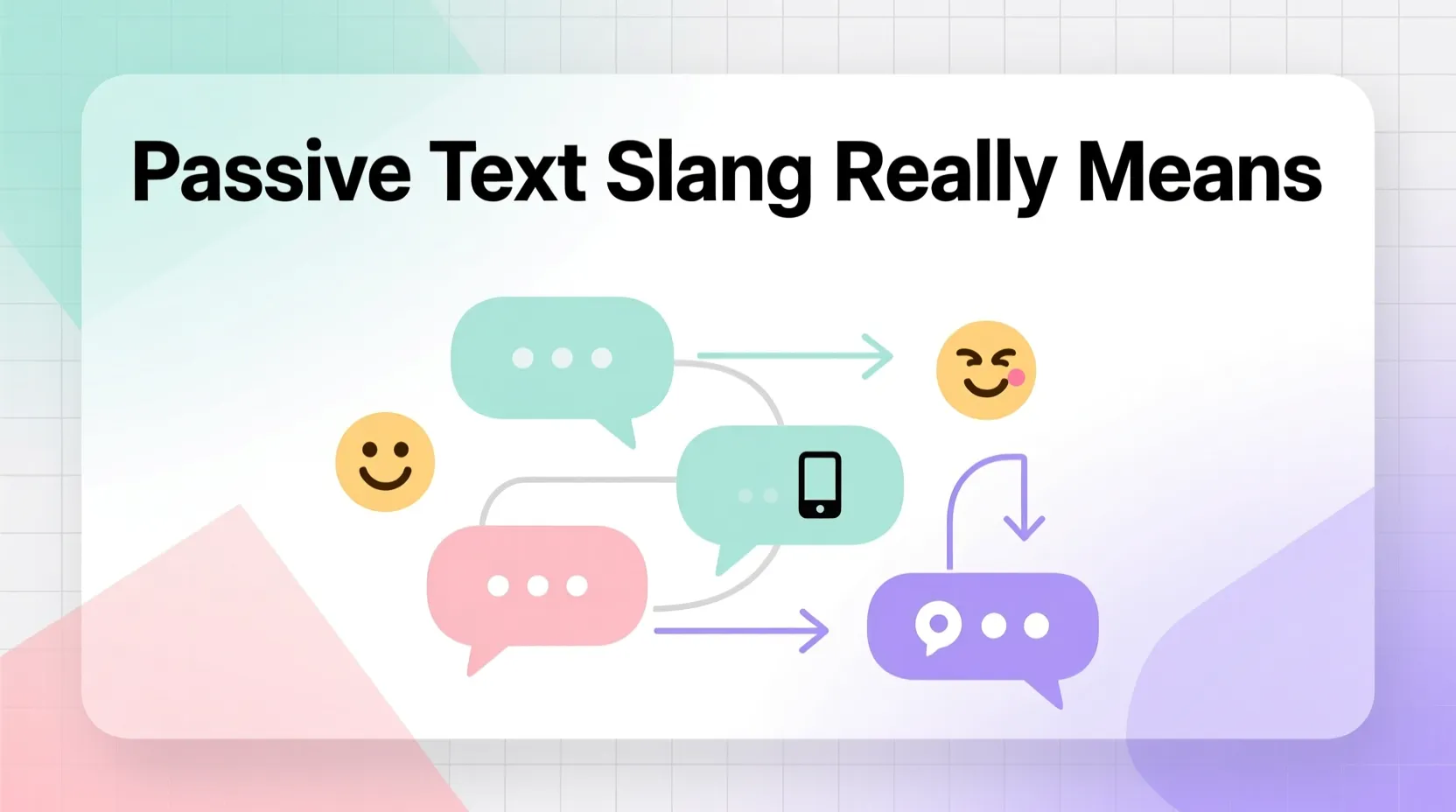
Have you ever been texting a friend and they reply with something like “sure, no problem” or just “k,” leaving you wondering if they’re annoyed, uninterested, or just busy? That’s what passive text slang often feels like—it’s subtle, indirect, and sometimes hard to interpret. If you’ve ever felt confused by these quiet but loaded messages, you’re not alone.
Quick Answer: Passive text slang refers to short, indirect, or understated responses in texting. It’s a casual, sometimes flirty or neutral way of communicating without showing strong emotion.
What Does Passive Text Slang Mean in Text? 🧠
Passive text slang is all about conveying a message in a subtle, understated way. Instead of being direct, the sender uses minimal words, sometimes leaving tone and emotion ambiguous. It’s not always negative; sometimes it’s friendly, nonchalant, or even playful.
Example:
A: “Hey, do you want to go out tonight?”
B: “Sure 😏”
Here, “Sure 😏” is a passive way of agreeing but can carry different undertones depending on context.
In short: Passive Text Slang = indirect/minimal response = understated or subtle messaging.
Where Is Passive Text Slang Commonly Used? 📱
Passive text slang is everywhere in casual digital communication. It’s popular on:
- Texting/SMS 📱 — Friends and acquaintances often use it.
- Snapchat 👻 — Short, snappy replies fit perfectly.
- TikTok & Instagram DMs 🎵📸 — Quick reactions or subtle flirting.
- Gaming chats 🎮 — Minimal responses during gameplay.
Tone:
- Mostly casual and social-media-friendly
- Sometimes flirty
- Rarely formal
Examples of Passive Text Slang in Conversation 💬
Here are 6 realistic chat examples:
Example 1:
A: “You coming to the party?”
B: “Maybe 😅”
Example 2:
A: “Can you help me with this task?”
B: “Sure, no problem 😏”
Example 3:
A: “Did you like the movie?”
B: “It was okay…”
Example 4:
A: “Want to grab lunch?”
B: “K”
Example 5:
A: “I’m feeling nervous about tomorrow.”
B: “You’ll be fine 😊”
Example 6:
A: “I didn’t get your last message.”
B: “Oops 😬”
Notice how passive text slang often leaves tone open to interpretation.
When to Use and When Not to Use Passive Text Slang 🕓
✅ When to Use
- Friendly casual chats with friends or family
- Flirty or playful situations
- Social media or gaming contexts
- To respond politely but briefly
❌ When Not to Use
- Formal emails or work communication
- Serious or urgent situations
- Conversations where tone must be clear
Comparison Table:
| Context | Example Phrase | Why It Works |
| Friend Chat | “No rush, sure 😄” | Casual & friendly |
| Work Chat | “Take your time.” | Polite & professional |
| “Please take your time to review this.” | Formal & clear |
Similar Slang Words or Alternatives 🔄
| Slang | Meaning | When to Use |
| K | Okay (short, neutral) | Casual chats |
| Meh | Indifference | Casual, joking |
| Sure | Agreement, neutral tone | Friendly/neutral |
| 😏 | Flirty or teasing agreement | Social media or DMs |
| lol | Light-hearted or playful | Friends, casual conversations |
| smh | Disapproval or disbelief | Informal, texting |
FAQs About Passive Text Slang ❓
Q1: Is passive text slang rude?
A: Not always. It can seem distant or indifferent, but context matters. It’s often casual or playful rather than intentionally rude.
Q2: How do I interpret passive messages?
A: Look at emojis, context, and the relationship with the sender. Tone can drastically change the meaning.
Q3: Can passive text slang be used professionally?
A: Rarely. It’s best to stick with direct and polite language in professional communication.
Q4: Is passive text slang the same as ghosting?
A: No. Ghosting is intentionally avoiding communication, while passive text slang is still engaging, just subtly.
Q5: Why do people use passive text slang?
A: It’s convenient, keeps messages short, and allows subtle expression of feelings without committing fully.
Conclusion
Passive text slang is all about subtlety. It’s a way to communicate without over-explaining or being too direct, making it perfect for casual chats, playful flirting, or social media exchanges. Understanding this slang helps you interpret messages more accurately and respond appropriately. Next time you see a “k,” “sure 😏,” or a simple emoji reply, you’ll know it’s more than just a word—it’s a nuanced piece of digital communication.

Mark Twain was born in Florida, Missouri, and grew up in Hannibal, a town along the Mississippi River that later inspired many settings in his famous novels. After his father’s death, Twain left school early and worked as a printer, riverboat pilot, journalist, and lecturer experiences that deeply influenced his writing.